
The Practical Homeowner’s Guide To Safe, Easy Storm Prep

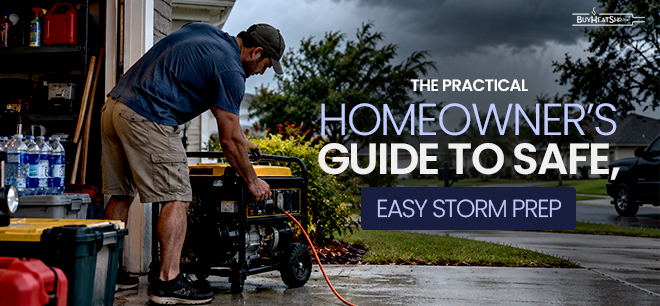
Severe storms in the USA have caused more than $406 billion in damage in the last four decades.
From late-season tornadoes to inland-moving hurricanes, storm season brings trouble from every direction. Heavy rains, pounding hail, aggressive storm fronts, and sudden outages hit hard. Millions of Americans stock up and take shelter while severe storms strain people and property.
When the weather turns, you need practical electrical prep that keeps you safe, keeps you powered, and keeps you ready for whatever storm season blows your way.
Storm Preparedness Is About More Than Supplies
Everybody thinks batteries, water, flashlights. Yes.
But that's the surface level. Real storm prep goes deeper.
We're talking generator wiring, outdoor electrical protection, temporary power and lighting, and indoor storm‑readiness. But before any of that, we have to address the elephant in storm season: safety.
Safety is the part every major agency agrees on. The big three—FEMA, CDC, and NOAA—each hammer home the same point: early awareness is the safest move you get.
Storms move fast. The safest decisions happen early. And smart storm safety starts long before the first gust or raindrop.
All agencies advocate for early action and safe evacuation. (Read about FEMA's safe Family Evacuation Plans.) Storm warnings and alerts give homeowners important information and time to react. A storm watch means conditions are possible. A storm warning means conditions are happening or imminent.
But the best thing to do is not wait until severe storms are overhead. Get your family to safety as the forecast evolves. And before the storm hits. Make a safety plan for and with your family.
Know where to take shelter in your home. Plan ahead for kids, pets, older adults, and people with disabilities. Protect people first. And possessions second. Don't forget about medications and safe water handling. It feels like a lot because it is.
- Explore FEMA's severe weather safety guidance
- Get severe storm safety basics from the CDC
- Stay safe with NOAA's severe weather guidelines
Storm season safety is a big deal, and pretty much all of it happens in the blink of an eye.
That's why staying safe during severe weather starts early. It starts with awareness and a plan. Because the safest decisions happen before the weather does.
When Outdoor Electrical Faces Severe Weather
Safety comes first during severe weather. But once your family has a plan in place, it's time to look at the systems that keep your home functioning before, during, and after a storm.
Severe weather tests every part of your property. Homes, businesses, rental properties, and outbuildings all face the same issue. Outdoor electrical connections are the most vulnerable and the most exposed to severe weather damage.
That means your outdoor lighting, wiring, and connections. It means your garden lights, water features, pumps, landscape wiring, detached building electrical, and any other exterior electrical power are all at risk for fast failure.
Rain, hail, humidity, temperature swings, and seasonal wear are bad enough. But severe storms make those problems so much worse. Homeowners with outdoor wiring need to take extra electrical safety precautions. And if you live in severe storm-prone regions, protecting your outdoor electricity isn't just "a good idea".
Outdoor electrical that faces severe storms must be sealed, secured, and properly protected. Or else they're going to fail…right when you need them most.
Here's What You Can Do:
The best time for homeowners to protect outdoor electrical systems is before severe weather enters the forecast.
Pick a nice, calm weekend. One with sun and a slight breeze. This isn't all doom and gloom. The goal for homeowners is to find and fix small weaknesses in your outdoor electrical now.
But we're going to make it really easy for you. Let's find those weak points before the storm does.
Here's How To Find It:
- Walk around and inspect all your outdoor wiring. (Take your morning coffee with you.)
- Do any connections wiggle or move when touched? (They shouldn't.)
- Look for discolored, thin, or damaged insulation (It's not protecting anymore.)
- Check for exposed wiring. (Visible metal = major danger. DO NOT TOUCH!)
- Do you see any rusty terminals? (Water is already getting in.)
- Are your wires or bundles loose or unsecured? (That's a hazard even before the wind.)
Here's How To Fix It:
- 3:1 Heavy Wall Adhesive Lined Heat Shrink – Strongest protection possible. Heavier walls. 100% Waterproof Seal. This one product stops Mother Nature from destroying outdoor wiring. Cut to size. Slide on. Heat up. Stop worrying.
- Dual Wall Heat Shrink Butt Splice Connectors – Looking for waterproof electrical connections? Crimp on. Seal out. Available in spade, ring, and step-down.
- Stainless Steel Cable Ties – Rustproof and flame-retardant. Loop it. Lock it. And keep your outdoor wiring secure in harsh outdoor conditions.
- Heavy-Duty Nylon Cable Ties – Fast, simple securing. Comes in multiple lengths and holds up to 250lbs.
Temporary Power Deserves Permanent Attention
The most common homeowner problem during severe weather is a dangerous power outage.
Losing power doesn't just mean sitting in the dark. Refrigerators stop running. Freezers defrost. Sump pumps stop protecting basements. Phones can't charge. The internet is down. First responders are stretched thin. And suddenly, temporary power is the only power you've got.
Storms can shut off the power to entire communities, counties, and even cities. What starts as an inconvenience quickly becomes a health and safety issue. The longer a power outage lasts, the more important reliable backup power becomes.
Downed power lines, damaged electrical equipment, and standing water create serious storm safety hazards. Food spoils. Water systems may be affected. And critical household equipment stops working when it's needed most.
Power outages are frustrating. They leave homeowners with one option: use temporary power until utility service is restored. That's why generators, emergency lighting, and backup power equipment deserve attention before storm season arrives.
Here's What You Can Do:
Don't wait for the lights to go out. It's a lot harder to untangle extension cords, test generators, or find a dead work light in the dark.
The goal is to reinforce and protect your backup power before the grid disappears. Let's make sure your home is the one on the block with reliable power during a severe storm power outage.
Don't worry. This doesn't require an electrician or a complete backup power overhaul.
Here's What To Look For:
- Do you know where to find your generator, extension cords, and work lights? (You'll need them soon. Explore FEMA generator safety tips.)
- Do your backup generator and emergency lights still turn on? (Now's the time to test.)
- Look for cracked, cut, or worn insulation on cords (Don't trust them.)
- Are your extension cords tangled, knotted, or kinked? (That can shorten their lifespan.)
- Check your indoor-to-outdoor electrical pass-throughs and abrasion points (These can be reinforced.)
Here's How To Fix It:
- PET Braided Cable Sleeving – Extra protection against friction and wear. Lightweight. Flexible. Expandable. Low profile. Slide it on. Shield abrasion points.
- Wrap-Around Sleeving – Protection without disconnection. Fast installation. Easy access later. Pre-slit. Lay the wire in. Secure it all.
- Hook & Loop Cable Ties – Fast and reusable. Extension and power cords to manage? Cleaner storage. Fewer tangles. Wrap it. Loop it. Leave it better.
The Small Details Can Make a Big Difference
When the power drops, you don't get time to hunt. You grab what's close and what you can find fast.
The storm is not the time to discover nothing's labeled and the small supplies you need are scattered across the house.
We're finally back to the batteries, flashlights, and water. Yes. Because every safety agency agrees: emergency kits and supplies should be kept in one central, easy-to-grab location. Keep them where you'll actually take shelter. Your family storm prep kit won't help you if it's buried in the back of your master closet or garage.
Bottom line: keep emergency supplies in a single location that everyone in your household can find and access. That way, you'll have what you need, when you need it. If the power goes out and you're scrambling…small details make a big difference.
Every family's storm‑season needs are different. What you pack depends on your home, your people, and the guidance you follow. Start with the essentials: water, lights, medications, first‑aid basics, communication, and the core items every emergency kit requires.
Once your main kit is built, you can add a few small, practical supplies that make your family's indoor storm‑readiness kit easier, safer, and faster to use.
Here's What We Recommend:
- Cable Tie Kits – Toss-and-go container. Mixed-length cable ties that do everything. Fast. Secure. Stays where you put it. (If you only add one item–THIS is it.)
- Label Makers – Use these to label everything in your kit. (They don't have to go in your kit.) Labels are about visibility, safety, convenience, and ease. Take the time now. When the storm hits, every second counts.
- Electrical Tape – Electrical safety sealing in a pinch. Sticks to almost all surfaces. Water-resistant. Temporary only. (Not a long-term fix!)
- Heat Shrink Kits – Quick repairs for wires and beyond. Precut. Comes adhesive lined (waterproof) or general purpose. Throw it in your bag and be prepared for more. (Worth having.)
- Pocket Butane Torch – Good for more than just heat shrink. Use it to heat, loosen, melt, and make quick repairs when other tools aren't available. (You'll find uses for it. We promise.)
These aren't replacements for storm prep essentials. They're small upgrades from BuyHeatShrink.com that help your whole family find what they need when the power goes out or the weather worsens.
BHS: Prep for the Worst with the Best
When the weather turns violent, the only thing you control is what you've already done.
A home with reinforced wiring, dependable backup power, and an organized indoor storm readiness kit handles the chaos a whole lot better than one scrambling in the dark. That's the real advantage of early prep — you steady your people, your property, and your peace of mind long before the storm ever shows up.
And when you've already walked the yard, tightened the weak spots, checked your temporary power, and stocked the gear your family actually uses, you've taken the edge off whatever comes next. You can't stop the sky from turning ugly, but you can make sure your home is ready to ride it out.
Stock up for storm season and prep for the worst with the best indoor and outdoor electrical supplies — only at BuyHeatShrink.com.


About the Author

Types of Heat Shrink: What They Are, and What They’re For
September 9, 2020
How To Remove A Cable Tie
August 10, 2020

10 Types of Electrical Connections and How They’re Made
March 10, 2021

The Top 10 Do's and Don'ts of Heat Shrink
November 10, 2023

How to Use Heat Shrink Wire Connectors
November 5, 2023
The Practical Homeowner’s Guide To Safe, Easy Storm Prep
October 28, 2026

The Best Off-Road Vehicle Upgrades for Reliable Trail Performance
October 15, 2026

The Complete Hunter’s Guide to Better Outdoor Gear
September 30, 2026
How to Measure Cable Diameter
September 29, 2026