
How Heat Shrink and Mil-Spec Keep Systems Airworthy

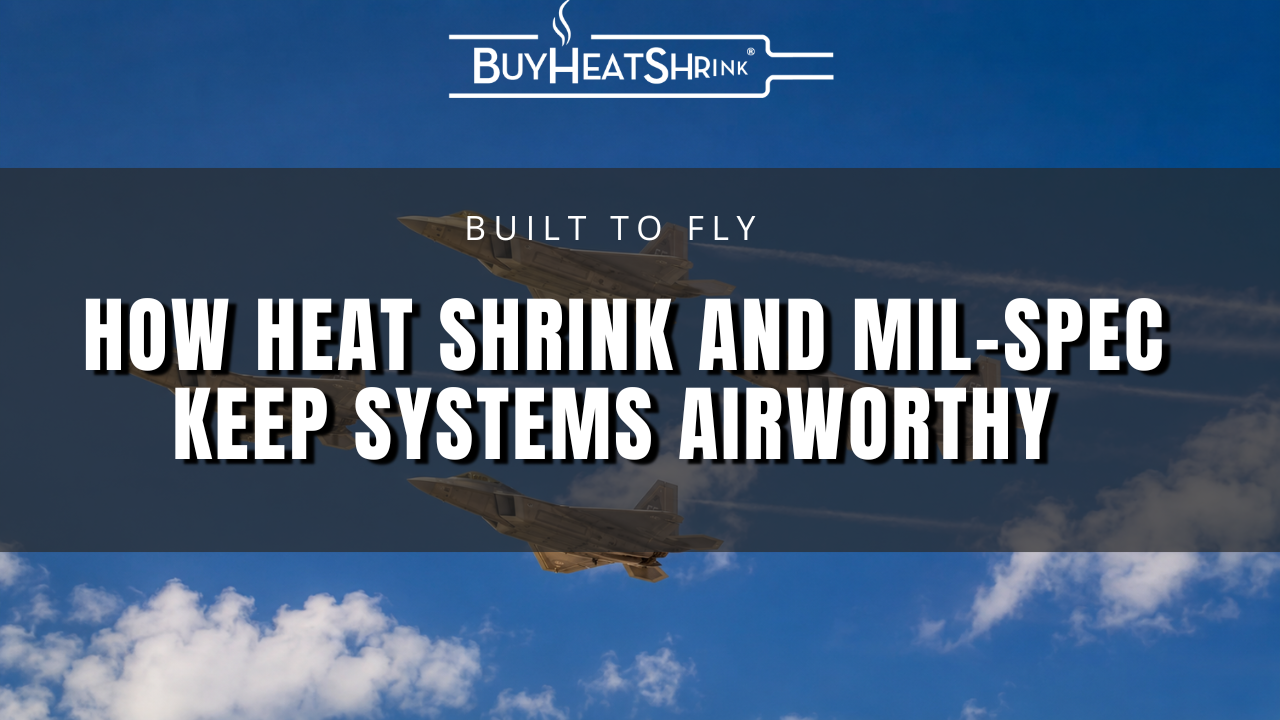
Flight is a marvel.
Humans have spent a century turning it into routine. Aerospace and defense teams take that work up into missions, orbits, and high-altitude paths. Where military vehicles, satellites, and unmanned aircraft share the sky with commercial and private aviation.
But for all the reasons we fly, only a handful of materials are truly engineered for the realities of a sky-high journey.
A Peek Inside the Wiring That Makes Flight Possible
Once an aircraft leaves the ground, everything depends on the systems keeping it in the sky.
Thousands of decisions, miles above the Earth's surface, and it all happens in real time.
Flight is only possible because thousands of tiny components don't fail. Every wire matters.
Wiring Architecture
Every aircraft starts with a wiring plan. The layout that decides how (and where) power and data move through the airframe.
Primary wiring carries power to flight-critical systems. These wires control maneuverability, navigation, and the pumps that feed fuel to the engines. Secondary wiring carries signals and data. These are the communications cables, wires, and cords. They talk to sensors, cabin systems, lighting, and environmental controls.
Branch lines split off to feed the equipment that supports the flight. They connect sensors, controls, and subsystems that keep the aircraft stable and responsive. Aerospace and defense wiring — any wiring that flies — must be designed to keep every flight-critical system powered, connected, and in control.
And because these wiring systems span the entire aircraft, the wiring has to move through tight spaces and complex structures.
Wiring Harnesses
Wires don't run through aircraft on their own. They're carefully, neatly organized into harnesses that group related circuits and guide them through the airframe. A harness keeps power and data on the right paths, even as it weaves through tight spaces and narrow structural frames. Aircraft wiring harnesses are the structures that keep signals clean, organized, and moving where they need to go.
Connectors & Terminations
Every wire in an airworthy system has a point of contact. Those points of contact are as important as the wire itself. Connectors, splices, and terminals create the electrical paths that link harnesses to avionics sensors, controls, and mission-critical equipment.
On aerospace and defense platforms, these interfaces must remain secure against vibration, shock, moisture, and electromagnetic interference. A weak connection isn't a small problem — it's a system that can't fly.
Protection Layers
Around every wire are the materials that keep it airworthy. Each layer is chosen for a specific purpose and applied to match the demands of the system it protects.
- Insulation & shielding: Prevents shorts, blocks interference, and preserves signal integrity across long runs.
- MUST BE: lightweight, flame-retardant, and stable under rapid temperature swings.
- Mechanical protection: Sleeving, heat shrink, and conduits defend against abrasion, vibration, and movement.
- MUST BE: pliable enough to route, strong enough to resist wear, and durable over thousands of flight hours.
- Environmental sealing: Barriers that protect wiring from fluids, pressure changes, and airborne contaminants.
- MUST BE: moisture-resistant, chemically compatible, and reliable from takeoff to landing.
Wiring is the nervous system of the aircraft. If it fails, the systems fail. But even with all these protections in place, wiring still has to survive the realities of flight.
Flight is Hostile: Wiring Dangers Inside Every Aircraft
Flight is hostile and complicated. It took humans more than a century of trial, error, and obsession to master it. And even now, humans can only take to the sky because of the miles of wiring that survive the flight.
Every wire on an aircraft has to survive conditions no ground-based system ever sees.
Hot Zones: Fire Protection
Hot Zones inside an aircraft aren't just "heat". They're continuous, concentrated sources of thermal energy generated by the engines, APUs, bleed-air ducts, and exhaust paths. None of it's accidental or avoidable.
Aircraft use thermal zones as part of their propulsion and environmental systems. High-energy air and exhaust travel through tightly controlled channels where temperature and flow rates are carefully managed. These pathways run hot by design — they carry the energy the aircraft needs to fly and remain active throughout the entire mission.
Wiring in flight systems is routed through these same corridors and must coexist with extreme heat, rapid thermal cycling, and hot metal framing without altering airflow patterns, maintenance access, or thermal load distribution.
Wet Zones: Chemical and Fluid Resistance
Every aircraft has fluid-heavy areas shaped by fuel lines, hydraulic circuits, water systems, de-icing agents, lubricants, cleaning solvents, and the condensation that forms inside the fuselage.
During flight, these fluids and chemicals move, atomize, and accumulate as part of normal aircraft operation. Even small amounts of mist, mixing, vapor, or residue become dangerous. From propulsion and landing to environmental controls, liquids have to travel through an aircraft safely. That means pressurized lines, reservoirs, and distribution channels running constantly.
Wiring in flight systems is routed through these same spaces. In zones where chemicals and fluids are present, contamination control, access, drainage, and ventilation are life-saving efforts, guided almost entirely by very well-protected wires.
Structural & Mechanical Zones
Aircraft move under force. Engines push. Airflow pulls. Landing gear slam. Control surfaces twist the airframe. It's all designed to move in flight.
Every major aircraft system feeds mechanical energy into the structure. That energy travels through beams, ribs, skins, brackets, and equipment bays. Stress, pressure, impact, abrasion, and vibration cannot be stopped. And they happen hard and fast.
Installing aircraft wiring means long runs through load-bearing spaces. Sudden hits. Sharp turns. Transferring forces. There's a lot of math and physics here. The aircraft (and its crew…if it has one) is constantly balancing support and survival to stay airborne.
Aircraft only fly when their wires stay anchored and secure while the structures around them refuse to stay still.
Pressure & Sealing Zones
Pressure doesn't stay steady in an aircraft. It rises, drops, equalizes, and rebalances as the aircraft climbs, descends, changes speeds, or shifts temperatures.
Aircraft manage pressure through engineered pathways. Ducts, valves, bulkheads, and specially sealed sections work together. They hold, redirect, and stabilize the air inside the cabin. Even small pressure swings can pull moisture into new areas, push air through seams, or force differential load movements where they shouldn't happen.
Sealing in an aircraft is a constant job, keeping pressure regulated and contained so the aircraft's internal environment is predictable. Air shifts. Loads adjust. Pressure tests every surface. Stability in flight depends on wiring, conduits, and terminations that stay properly sealed at their ends and interfaces so the aircraft can maintain the pressure it needs to fly.
We chose the environment. Flight creates the threats. The only reason humans can take to the sky at all is because of the mission-grade materials that make flight possible.
The Mil-Spec Materials Behind Mission-Critical Performance
The United States Military and U.S. Department of Defense use Mil-Spec or "military specifications" as the official standards for products, equipment, and material use. This is where product reliability is measured, documented, and enforced. The government can't rely on commercial-grade assumptions. (And they're not reading product reviews.) This is another league entirely.
The Department of Defense (along with other agencies like the DLA) outlines the exact performance, durability, and testing requirements a material must meet before it's allowed in defense and government aerospace systems.
They need proof that a material will behave the same way, every time, under the same conditions, across every batch. That consistency is what keeps systems predictable and safe. It keeps engineers aligned across builds, and crews aligned across missions.
Mil-Spec isn't a label; it's a guarantee. It's documented evidence that this material, this product, this pick is the best at what it does. Every time. Without fail. Because that is exactly what flight demands.
Only a handful of materials can clear that bar.
Industrial Grade Firesleeve
Industrial Grade Firesleeve is the thermal shield. Silicone-coated fiberglass protects aircraft wiring, cables, and hydraulic lines in high-heat flight environments and radiant energy zones. It's spec'd into areas where thermal exposure is expected, not optional.
Our Industrial Grade Fire Sleeving is built for the kind of heat that compromises ordinary insulation. The knitted fiberglass core and high-grade silicone coating create a flexible barrier engineered to withstand high-temperature exposure in flight systems. It doesn't melt or drip. It chars and insulates. This is the flame-retardant layer that all flight systems need.
Known For:
- 500°F continuous protection
- 1200°C molten-splash resistance
- Fuel + Chemical resistance
- Halogen-free
- Made in the USA
Flies In: commercial aircraft, military jets, unmanned drones, satellites, NASA vehicles
PTFE
PTFE is the chemical-proof protection. Its fluoropolymer construction doesn't flinch at jet fuel, hydraulic fluid, solvents, or the constant heat swings inside a flight system. Its low-friction exterior reduces drag and helps wiring move cleanly through tight routes and channels.
Our 4:1 PTFE Heat Shrink Tubing is built for environments where chemical exposure is constant, heat is high, and failure must be nonexistent. Its rigid profile delivers a precise, abrasion-resistant, thermally protective shield that's resistant to almost every known chemical. It's also low outgassing, sterilizable, and Mil-Spec approved.
Known For:
- Outstanding chemical resistance
- Up to 500°F continuous protection
- Limited Oxygen Index > 95
- Flame rating UL94 V0 and VW-1
- FDA + USP Class VI
Flies In: U.S. military vehicles, DoD flight programs, passenger and cargo planes, government and research flight systems
Polyolefin
Polyolefin is a lightweight layer of protection for just about every wiring surface in a flight system. It delivers clean electrical protection, dependable abrasion resistance, and a smooth routing profile that's easy to install.
Our 2:1 Polyolefin Heat Shrink Tubing shrinks fast, grips tight, and stays stable. It's made from cross-linked polyolefin that meets Mil-Spec and AMS-DTL-23053/5. This is aerospace-grade electrical insulation that carries a UL 224 VW-1 flame rating (in non-clear colors). It's Mil-Spec, CSA OFT recognized, and is trusted across military and commercial harness production for its clean shrink performance and reliability.
Known For:
- 135°C continuous use temperature
- 2:1 shrink ratio
- Dielectric strength: 600 V/mil
- Available in long-run spools, multiple diameters, and now in bulk
Flies In: avionics bays, cabin and fuselage wiring, UAVs, drones, and most flight-system harness builds
Adhesive Lined Polyolefin
Adhesive lined polyolefin is the best environmental seal for aircraft wiring. Its dual-wall design combines cross-linked polyolefin with a pre-lined, interior wall of hot-melt adhesive to lock out moisture, dust, pressure changes, and all contaminants.
Our adhesive lined polyolefin family includes dual-wall heat shrink tubing, heavy-wall heat shrink tubing, and heat shrink end caps. Each format shrinks, melts, and cures into a watertight, airtight seal.
Aerospace and defense systems, along with commercial and private aviation, use adhesive lined polyolefin for splice encapsulation, connector-to-cable transitions, plugs, and interfaces where condensation, fluid splash, or pressure differentials are an issue during flight.
Known For:
- AMS-DTL-23053/4 dual-wall moisture barrier
- Hot-melt adhesive activation and flow
- Bonded environmental seal
- Mechanical stability under vibration
- Available as:
When you look at cross-linked polyolefin, PTFE, and industrial-grade firesleeve, you see the pattern. Each one solves a specific problem in a specific zone. And each earns its place through documented, repeatable performance.
BHS: Trusted Across Air, Space, and Defense
Across air, space, defense, commercial aviation, and unmanned platforms, BHS materials show up consistently and get the job done. They have to because our products don't just protect aircraft wiring – they protect people.
At BuyHeatShrink.com, we stock Mil-Spec materials built for the thermal, chemical, electrical, and environmental rigors of flight. We offer bulk quantities, maintain reliable inventory, and provide free samples so your teams can verify fit and performance before installation. When you need dependable protection for critical aircraft wiring, we have it ready to ship.
Whether you're the one flying high or your drone is, without wires there is no flight. And without the proper protection around those wires, those wiring zones, and those aircraft, we'd never get off the ground.
Flight is a marvel…that depends on wiring. That's where we come in.
Explore all of BuyHeatShrink's high-temperature, high-performance, Mil-Spec compliance materials on our Aerospace & Military Industry Page. And keep looking up.


About the Author

Types of Heat Shrink: What They Are, and What They’re For
September 9, 2020
How To Remove A Cable Tie
August 10, 2020

10 Types of Electrical Connections and How They’re Made
March 10, 2021

The Top 10 Do's and Don'ts of Heat Shrink
November 10, 2023

How to Use Heat Shrink Wire Connectors
November 5, 2023

The Complete Hunter’s Guide to Better Outdoor Gear
September 30, 2026
How to Measure Cable Diameter
September 29, 2026


Road-Worthy: How Sleeving Helps Long-Haul Trucking & 18-Wheelers Get It Done
September 10, 2026
How To Waterproof Home Swimming Pool Wiring
August 13, 2026